
Bridging Craft and Science: Rebuilding and Restoring Altadena and Pasadena Historic Homes
.jpg)
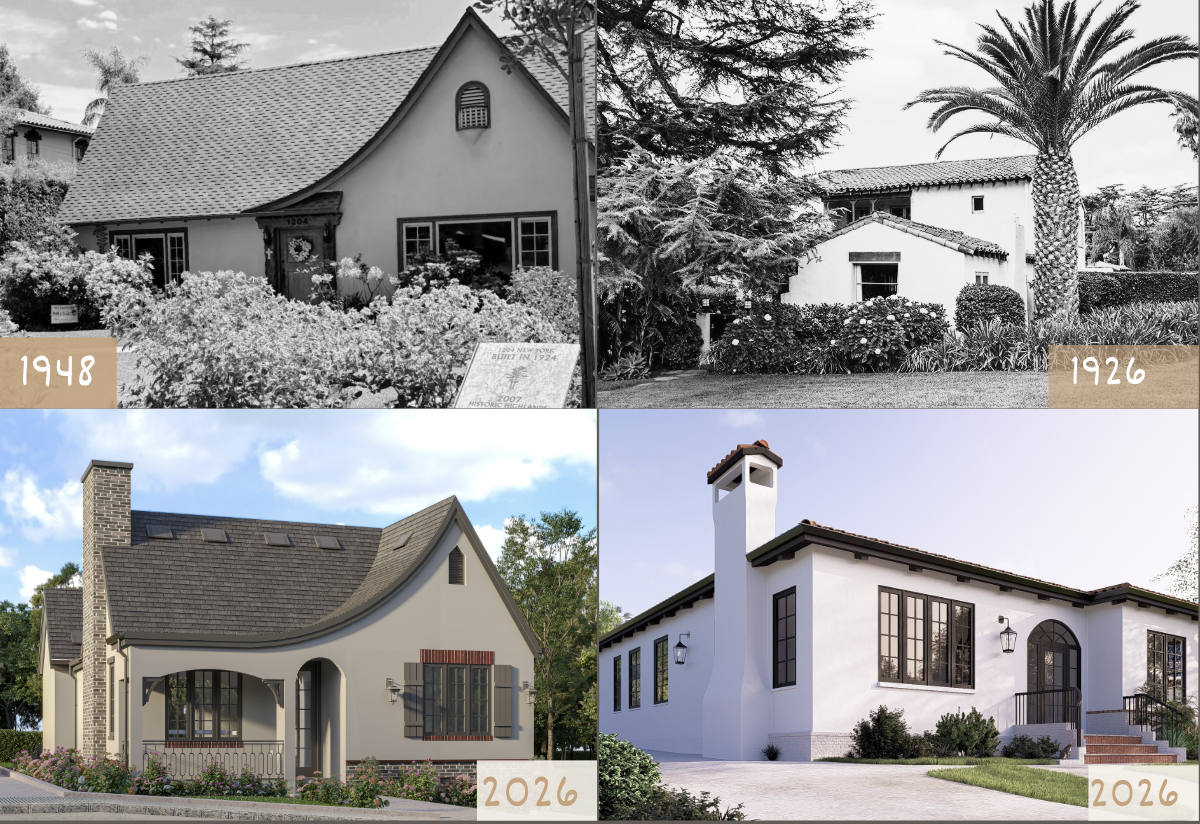
When people talk about preserving the character of Altadena's historic homes, they are pointing at something real and specific. The neighborhood developed primarily between the 1910s and the 1950s, and its residential fabric reflects the architectural fashions of those decades: Craftsman bungalows with deep front porches and exposed rafter tails, Spanish Colonial Revivals with curved rooflines and terra cotta tiles, English Cottages with steeply pitched roofs and leaded glass windows, and modest Mid-Century Modern homes tucked into the hillside vegetation.
These homes were built by craftspeople using techniques and materials that have largely disappeared from standard residential construction. The swooping curves of a cottage roof were shaped by hand. The proportions of a window casing reflected the judgment of a skilled finish carpenter. The warmth and texture of an original hardwood floor came from old-growth timber that no longer exists in commercial quantities.
Rebuilding these homes faithfully is not simply a matter of aesthetics. For many Altadena homeowners, the character of the original design is the entire motivation for rebuilding rather than simply taking an insurance payout and starting over. And for the community as a whole, the character of what gets built in the next three to five years will define the neighborhood's identity for the next several decades.
Enhaus Design Build approaches the Altadena rebuild not by replicating the past using inferior modern shortcuts, nor by treating the rebuild as a blank slate. The approach is to use every available tool in modern materials science and construction technology to rebuild homes that look, feel, and perform the way the originals would have if they had been built with today's knowledge.
Pasadena Historic Home Renovations: Navigating Preservation Requirements
While Altadena's challenge is primarily one of rebuilding from scratch within a historic character framework, Pasadena's challenge is different: how to sensitively renovate homes that may be individually listed on the National Register of Historic Places, located within one of the city's designated historic districts, or subject to a Mills Act contract that provides property tax benefits in exchange for preservation commitments.
The City of Pasadena maintains an exceptionally active Historic Preservation Program. The city has designated hundreds of individual landmarks and multiple historic districts, including Bungalow Heaven, the Arroyo Seco corridor, and residential blocks where the concentration of intact early twentieth-century architecture is unusually high. Renovating a home in any of these contexts requires careful navigation of design review processes, material specifications, and often a formal Certificate of Appropriateness before work can begin.
Enhaus Design Build brings to the execution side a construction team that understands why preservation specifications matter and knows how to build to them. The challenges that come up most frequently in Pasadena historic home renovations include window replacement, roof work, fireplace updates, flooring, exterior insulation and weatherization, and structural improvements that must be made without compromising visible historic fabric. Each of these is addressed in detail below.
Roofs: From Hand-Formed to High-Performance Without Losing the Curve
One of the most distinctive and technically challenging elements in Altadena and Pasadena historic home architecture is the swooped or curved roofline. Found most commonly on English Cottage and early Craftsman-influenced homes, these curves were originally created by hand. A skilled carpenter would notch and steam-bend individual framing members to achieve the desired profile. The results were beautiful but slow, wasteful, and inconsistent.
Modern construction has largely abandoned this technique, not because the aesthetic is no longer valued, but because the skilled labor required to execute it has become extremely scarce. The default move for most contractors is to skip the curve entirely or attempt a rough approximation that fails to capture the genuine sweep of the original.
Enhaus takes a different approach. Rather than abandoning the curve or approximating it with a crude workaround, the team uses precision-cut radiused blocking and pre-bent cedar shingles manufactured off-site to exact specifications. The radiused blocking creates the structural curve with factory-level precision, eliminating the waste and inconsistency of hand-notching. The pre-bent shingles arrive ready to install in a consistent profile, resulting in cleaner swoops that install faster while maintaining the visual authenticity of the original form.
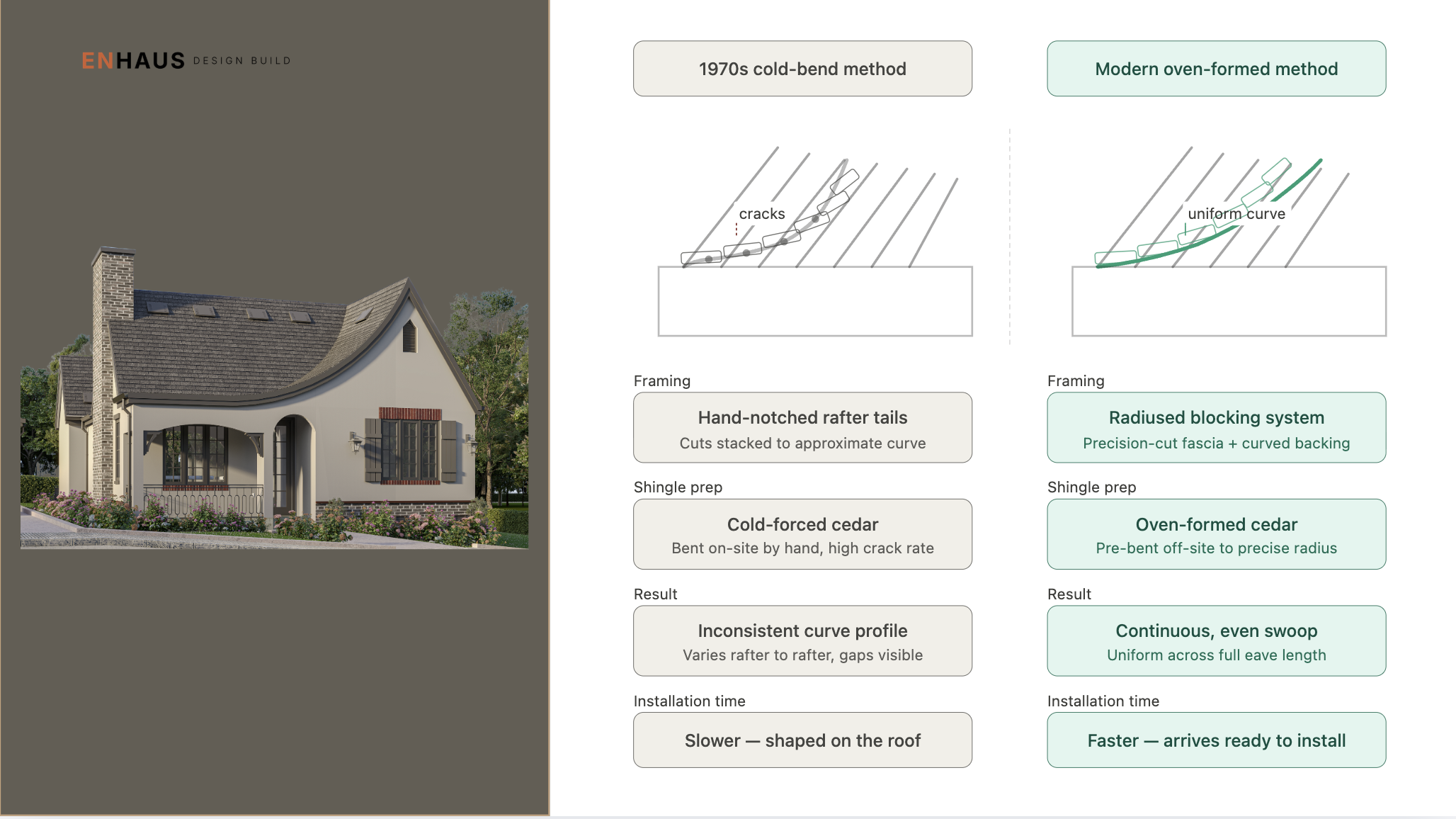
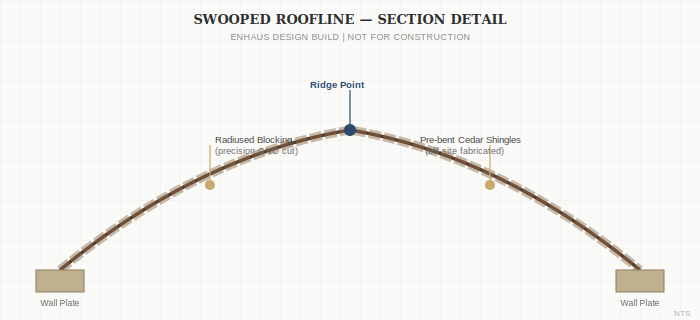
Figure 1: Swooped Roofline Section Detail — Enhaus Design Build. Radiused blocking and pre-bent cedar shingles restore historic cottage profiles to modern precision. NOT FOR CONSTRUCTION.
For Altadena rebuilds, this means a homeowner who lost a beloved English Cottage to the fire can rebuild with a roofline genuinely faithful to what they lost. For Pasadena historic home renovations involving roof replacement, this technique satisfies preservation review requirements while meeting modern water management and fire resistance standards.
Fireplaces: Historic Aesthetics with Contemporary Safety and Efficiency
The fireplace has always been central to the character of a Foothill home. In the 1920s and 1930s, a well-crafted brick fireplace was both a functional heating source and a social focal point. The surround, the mantel, the tile work, and the proportions of the opening all carried meaning.
Contemporary fireplace technology has changed significantly. Modern prefabricated units are dramatically safer, more efficient, and easier to maintain than traditional masonry fireplaces. They incorporate sealed combustion chambers, integrated air intake systems, and exhaust designs that meet current California building and air quality codes in ways that open masonry hearths cannot.
The design challenge is integrating modern fireplace technology in a way that does not betray the historic character of the room. Enhaus addresses this by specifying contemporary units whose compact profiles are easier to frame within a traditional masonry or tile surround, then building those surrounds with the same quality of brick, intricate tilework, and pattern detailing that characterized the original homes.
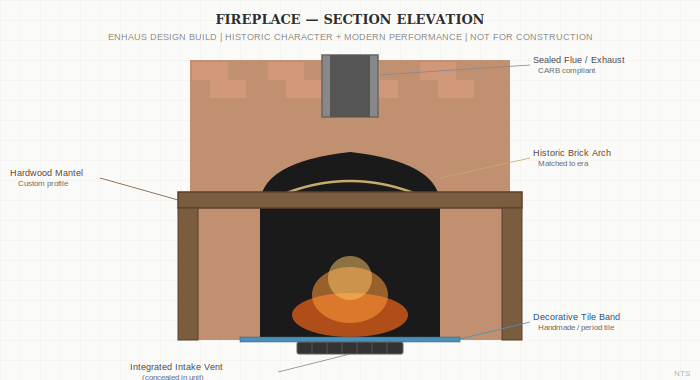
Figure 2: Fireplace Section Elevation — Enhaus Design Build. Modern sealed firebox with integrated intake set within a traditional brick-and-tile surround. NOT FOR CONSTRUCTION.
The result is a fireplace that reads as entirely authentic from the living room but performs to modern standards behind the scenes. The intake vent is integrated within the unit, allowing a cleaner, more traditional-looking surround. The combustion system meets California Air Resources Board requirements.
Window Science: Title 24 Performance Inside Historic Profiles
Windows are one of the most technically complex elements in any historic home renovation or rebuild. California's Title 24 Building Energy Efficiency Standards mandate specific performance characteristics for windows in residential construction, including requirements for solar heat gain coefficients, U-factors, and air infiltration rates that older single-pane windows cannot meet.
At the same time, the windows of Altadena and Pasadena historic homes are often among their most architecturally significant features. The divided light patterns of a Craftsman window, the arched transoms of a Spanish Revival, and particularly the stained glass panels found in many early twentieth-century homes carry enormous aesthetic and historic value.
Enhaus specifies windows that comply with Title 24 requirements while maintaining the traditional aesthetic of the original design. For standard windows, this means double-glazed units with multipoint locking systems for better sealing, manufactured in traditional divided-light profiles that reproduce the shadow lines of true muntins while meeting modern energy performance standards.
For stained glass, the approach is elegant and technically sound. Original or reproduction stained glass panels are sandwiched between two clear glass panes in an insulated glass unit. The stained glass is fully protected from weather, UV degradation, and physical damage on both sides, while the insulated unit provides the thermal and air infiltration performance required by Title 24.
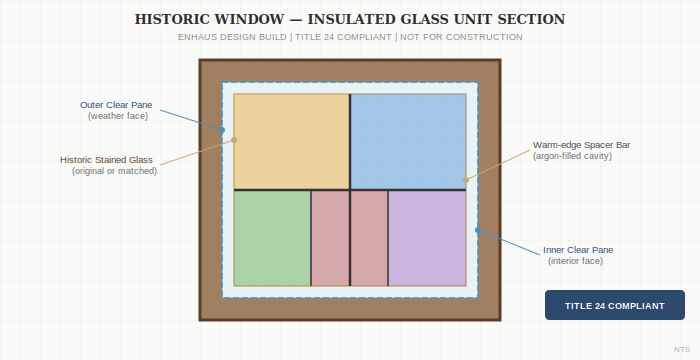
Figure 3: Historic Window IGU Section — Enhaus Design Build. Stained glass panel sandwiched between two clear panes in a warm-edge argon-filled unit. Title 24 compliant. NOT FOR CONSTRUCTION.
This approach is particularly valuable for Pasadena historic home renovations involving designated landmarks or Mills Act properties, where replacement of original stained glass with standard modern materials could trigger preservation review problems or jeopardize the property's historic designation.
Engineered Flooring: Solving the Problems Solid Hardwood Could Not
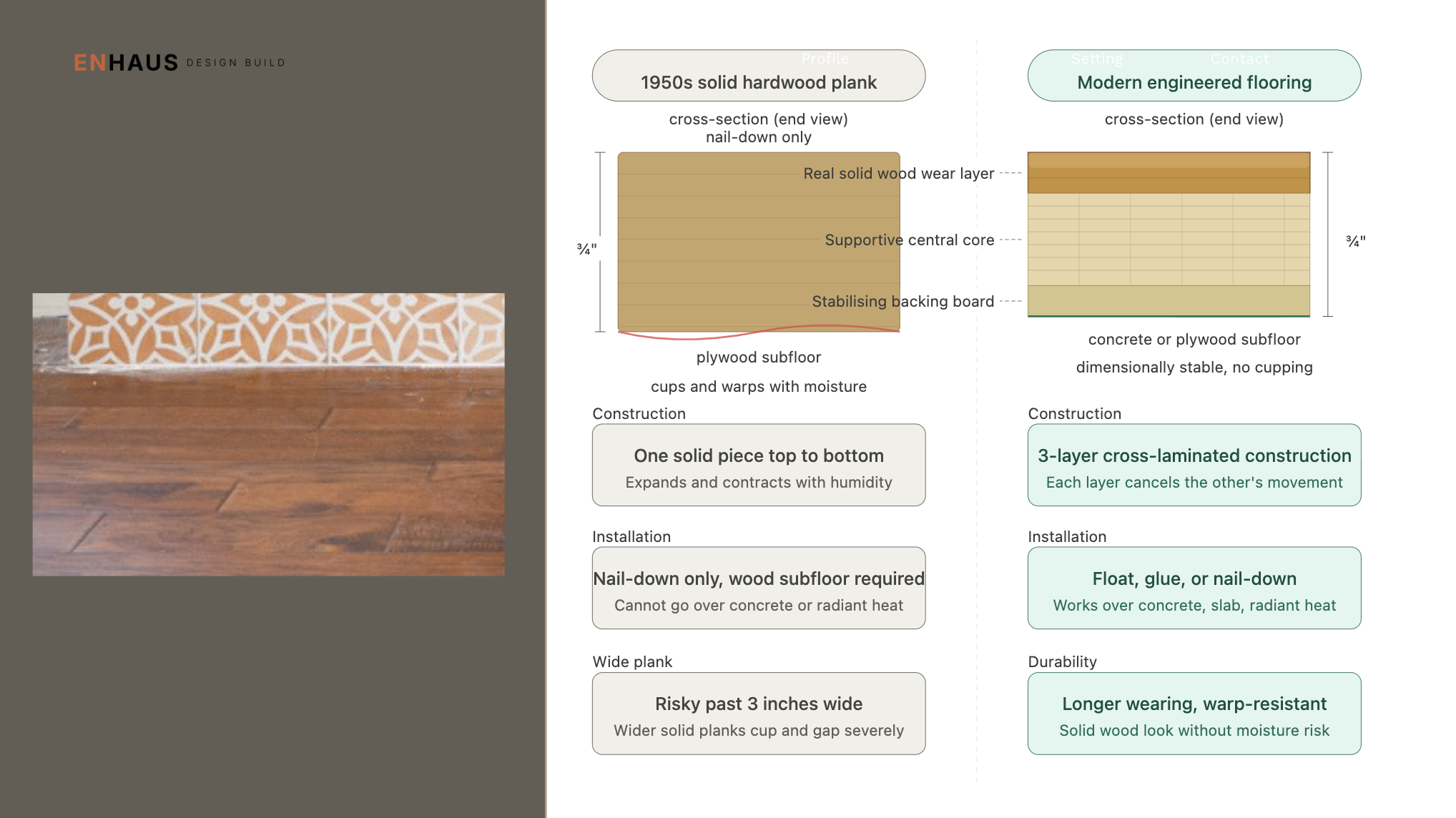
Original solid hardwood floors are one of the most beloved features of Altadena and Pasadena historic homes. Quarter-sawn oak, Douglas fir, and heart pine floors from the early twentieth century have a depth of color and a patina that modern materials rarely replicate. They are also, in many cases, genuinely irreplaceable. The old-growth timber species used in floors from the 1920s through the 1940s are no longer available in commercial quantities.
For Altadena rebuilds starting from scratch, or for Pasadena historic home renovations where the original flooring has been lost or damaged beyond repair, the decision is more complex. Solid hardwood is one option, but it comes with well-documented problems in California's climate. Wood expands and contracts significantly with changes in humidity and temperature, and the dry Los Angeles basin, combined with the well-insulated, climate-controlled environments modern homeowners expect, creates conditions where solid hardwood floors frequently develop cupping, gapping, and surface checking over time.
Modern engineered hardwood flooring addresses these problems directly. An engineered floor uses a real hardwood veneer over a dimensionally stable plywood or composite core, dramatically reducing the expansion and contraction response that causes solid wood floors to fail. The result maintains the visual character of a genuine hardwood floor while performing reliably in the conditions of a tightly sealed modern home.
For Altadena rebuilds being built to modern energy efficiency and air-sealing standards, engineered flooring is often the more responsible choice than solid hardwood, even for homeowners who want the most authentic possible appearance.
Advanced Wall Systems for the Altadena Rebuild
Beyond the historically visible elements of roof, windows, fireplace, and flooring, the Altadena rebuild presents an opportunity that does not exist in existing-home renovation: the ability to choose wall and insulation systems from scratch. The choice of wall system and structural material will determine how the home performs in earthquakes, wildfires, and climate extremes for the next fifty to one hundred years.
Insulated Concrete Forms (ICF)
Insulated Concrete Forms consist of interlocking foam blocks that serve as the permanent formwork for a reinforced concrete structural wall. The foam remains in place after the concrete is poured, providing continuous insulation on both sides of the structural element.
The result is a wall system with exceptional structural integrity, excellent thermal mass, high insulation values, and outstanding resistance to both fire and seismic forces. For Altadena rebuilds in the Wildland-Urban Interface fire hazard zone, ICF construction offers a level of fire resistance that wood-frame construction cannot match. For the seismic environment of the greater Los Angeles area, the continuous reinforced concrete structure provides superior lateral force resistance.
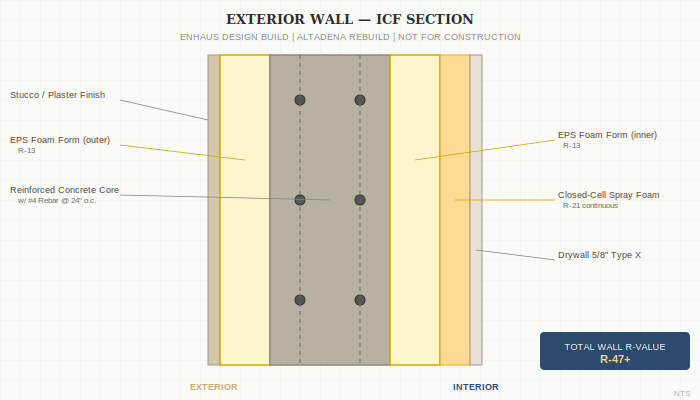
Figure 4: ICF Exterior Wall Section — Enhaus Design Build. EPS foam forms with reinforced concrete core and closed-cell spray foam interior layer. Total R-47+. NOT FOR CONSTRUCTION.
Closed-Cell Spray Foam Insulation
Closed-cell spray polyurethane foam simultaneously provides exceptional thermal insulation, creates an air barrier that eliminates infiltration, and adds structural rigidity to the framed assembly it fills. Applied in wall cavities, roof assemblies, and rim joist areas, it consistently delivers dramatically better energy performance than standard code minimum insulation requirements.
Autoclaved Aerated Concrete (AAC)
Autoclaved Aerated Concrete is a factory-manufactured masonry product cured under steam pressure. The manufacturing process creates a lightweight cellular structure that is simultaneously strong, thermally insulating, highly fire-resistant, and dimensionally precise. AAC has been widely used in Europe and the Middle East for decades and is gaining traction in California residential construction, particularly in wildfire-prone areas.
GigaCrete and Advanced Plaster Systems
GigaCrete and similar advanced cementitious plaster products offer performance characteristics far beyond traditional stucco or drywall: fire-resistant, highly durable, and formulated to resist mold and moisture. For Altadena rebuilds with Spanish Colonial or Mediterranean exterior aesthetics, these products achieve the textural character of traditional stucco with modern performance properties built in.
3D Printed Concrete
Three-dimensional concrete printing extrudes a specially formulated concrete mixture through a computer-controlled nozzle, building up structures layer by layer according to a digital model. For the Altadena rebuild, 3D printed concrete offers possibilities for recreating complex architectural forms and ornamental details with a level of precision and repeatability that traditional formwork cannot achieve economically.
Hempcrete
Hempcrete is a biocomposite building material made from the inner core of the hemp plant mixed with a lime-based binder. Hempcrete walls breathe, regulating moisture passively rather than blocking it, which reduces condensation and mold risk. They are also fire-resistant, pest-resistant, and over their lifetime absorb carbon dioxide as the lime binder continues to carbonate. For homeowners specifically motivated by sustainability goals, hempcrete offers real performance advantages.
Frequently Asked Questions About Altadena Rebuilds and Pasadena Historic Home Renovations
How long will it take to rebuild in Altadena after the Eaton Fire?
The design and permitting phase for a custom rebuild typically takes six to eighteen months depending on complexity and the responsiveness of the Los Angeles County permitting process. Construction typically takes twelve to eighteen months once permits are in hand. Homeowners who engage a qualified builder early and pursue streamlined permitting pathways where available will generally experience shorter overall timelines.
Do I have to rebuild in the same style as my original home?
For most Altadena properties, there is no regulatory requirement that a rebuild replicate the style of the original home. However, some properties may have deed restrictions, neighborhood covenants, or location within an area subject to local design guidelines that constrain stylistic choices. The County of Los Angeles has also established specific design standards for rebuilds in certain community plan areas. A builder familiar with the specific regulatory context of your property, such as Enhaus Design Build, can advise on what flexibility actually exists.
What are the fire-resistant building requirements for Altadena rebuilds?
Altadena is designated as a Very High Fire Hazard Severity Zone and is subject to Wildland-Urban Interface building code requirements. These include specific requirements for exterior wall construction, roof assemblies, vent protection, window glazing, deck materials, and landscaping setbacks under Chapter 7A of the California Building Code. Meeting these requirements is not optional. However, the choice of specific materials and systems to meet them is flexible, and working with builders familiar with the available options allows homeowners to meet the code while also achieving their design goals.
Can I modernize my Pasadena historic home without losing its historic designation?
In most cases, yes. Historic designation does not mean a home must be frozen in time. The Secretary of the Interior's Standards for the Treatment of Historic Properties explicitly contemplate rehabilitation work that makes historic properties compatible with contemporary use. Enhancements to mechanical systems, insulation, plumbing, and electrical infrastructure that are not visible from the exterior are generally not subject to design review at all.
How do I choose between different wall systems for an Altadena rebuild?
The right choice depends on a combination of budget, desired performance outcomes, schedule, and aesthetic goals. ICF offers the highest level of fire resistance and structural performance at a higher cost than wood framing. Closed-cell spray foam within a conventional wood frame provides excellent energy performance at a moderate premium. AAC block offers a middle path with good fire resistance, thermal performance, and ease of construction. The best approach is to have a qualified builder review your specific site and goals before making a system selection.
What does historic home renovation cost in Pasadena compared to standard renovation?
Historic home renovation in Pasadena typically carries a cost premium of ten to thirty percent above standard renovation costs, depending on the scope of work and the nature of the preservation requirements. The premium reflects additional design review time, higher material costs for historically matched finishes, and the skill level required from tradespeople executing the work. For properties with a Mills Act contract, the property tax savings available over the life of the contract can substantially offset that premium.
Why the Right Builder Matters More Than Ever
The Altadena rebuild and the ongoing task of sensitively renovating Pasadena's historic homes are not challenges that can be met with off-the-shelf solutions. They require builders who have the technical knowledge to navigate complex regulatory environments, the construction expertise to execute with precision, and a genuine respect for the communities they serve.
Enhaus Design Build was built for exactly this kind of work. Robert Chuang and Bader Jaffan bring the engineering rigor and project management discipline of large-scale commercial construction to the residential sector. Whether you are a family beginning to think about rebuilding a home lost in the Eaton Fire, an Altadena property owner evaluating your options, or a Pasadena homeowner considering a renovation of a landmark property, the conversation to have is not just about what you want to build. It is about finding a team that can bridge the past and the present.
"Altadena's historic homes carry character that modern builds rarely replicate. Modern science solves problems old methods couldn't. These are the crafts, conversations, and technologies making that possible right now."
That bridge is what Enhaus Design Build was built to cross.